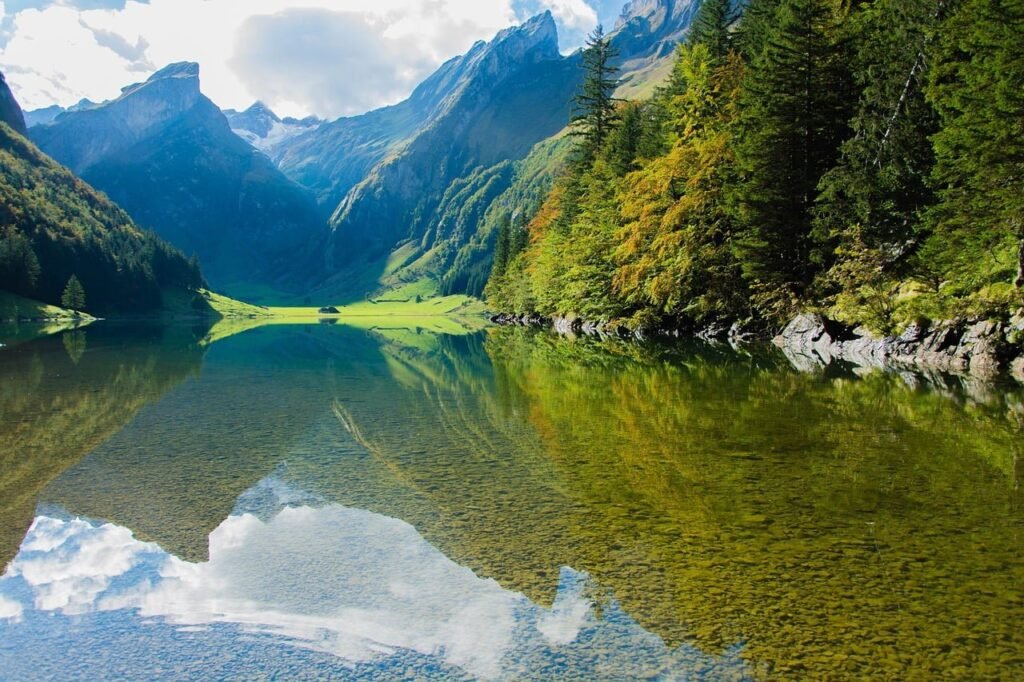
Sigulda (formerly also spelled Siggulda); a town in Latvia (10.6 thousand inhabitants in 2005), approximately 50 km north-east of Riga, on the edge of Latvia’s Gauja National Park, the so-called “Switzerland of Latvia”, on the Gauja River gorge. A tourist center, resort, winter sports area (bobsleigh track, ski lifts); Sigulda railway station.
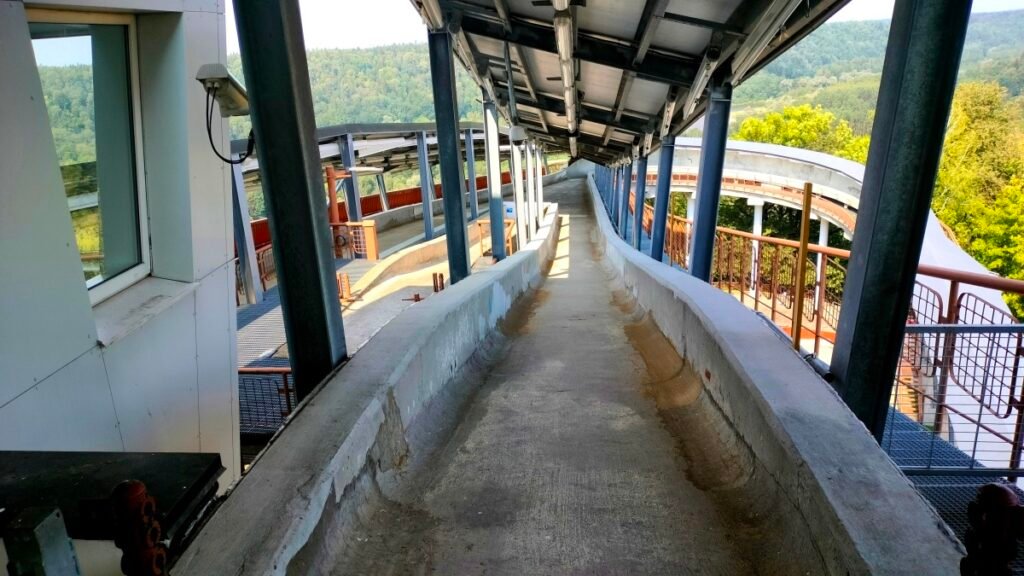
*Sigulda is known for its bobsleigh track. Due to the lack of such a facility in Poland, Poles practice on the track there. Visitors can also ride a real bobsleigh (with a pilot, at slower speeds than the professionals). The Valmiera ski jumping complex and the Gavia cable car are also located here.
*Sigulda is one of the towns located within the Guaja National Park, whose name derives from the river that meanders through its entire territory. Surrounded by green hills, the town also boasts three magnificent medieval castles and several other noteworthy monuments and attractions. Sigulda is divided by the Guaja River, and dense forests on both sides stretch to the horizon. The towers of medieval castles and several modern structures, jutting out from the greenery here and there, are reminders of human presence. It’s worth noting that this area has the highest concentration of castles not only in Latvia but also in Eastern Europe. The entire area of Latvia’s oldest national park is exceptionally picturesque, attracting many Latvians and foreign tourists in their free time.
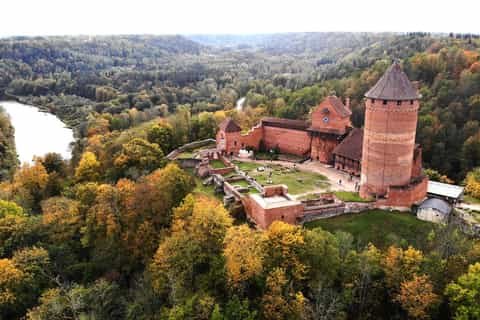
*TURAID CASTLE. We begin our tour in the northern part of Sigulda. This is a vast, 42-hectare park complex with a wealth of interesting structures. Here, we’ll find sculptures, springs, viewpoints, small museums, a charming church, and the jewel of the entire complex: a medieval castle located at the end of the park. We continue up the main path, pass a souvenir shop, and climb the stairs to the red church towering above the path. Turaida Church, built in 1750, is one of the oldest wooden churches in Latvia. It has survived to this day without significant changes, and until the 18th century, the church was a cemetery. An exhibition devoted to the Livonian people is located in the restored gardener’s house on the old Turaida estate. The Livonians are the second indigenous people of Latvia, with an ancient culture and rich history. Evidence of Livonian culture can be found in many places. On the Turaida hillfort, where a wooden Livonian castle once stood, on the church hill where the first baptized Livonians were buried, or on Jelgavkalns hill, where a Livonian village had long been located. The southeastern part of the museum complex is the main focus of our visit. The massive red brick structure is visible from the entire Guaja River valley. Construction of Turaida Castle began in 1214 on the orders of Bishop Albert of Riga, on the site of a previously existing wooden Livonian stronghold. In the Middle Ages, Turaida Castle was just one of the archiepiscopal castles in this area. The Archbishop of Riga used this castle not only as a residence but also as a refuge outside of Riga.

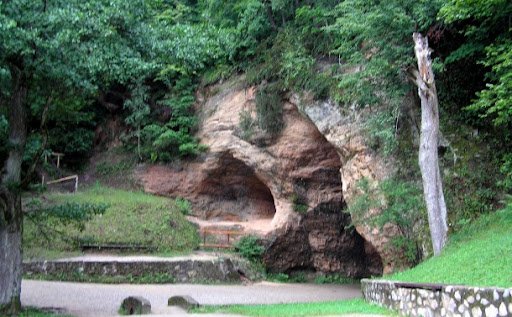
*GUTMAN’S CAVE. Gutman’s Cave should actually be called a grotto, as it’s just a depression in the rock. It looks impressive, however, especially since the sandstone rock is a deep orange, standing out against the greenery. At 12 meters wide and 10 meters high, it is the largest cave in Latvia. Its walls are adorned with numerous inscriptions carved by visitors over the centuries, the first of which may date back to the 16th century. Legend has it that the cave was the scene of a tragic love affair between the girl Maija, nicknamed Rose of Turaida, and Viktor, the castle gardener. Just outside the cave, on the left, are wooden stairs leading to an observation deck. However, the deck is heavily overgrown and practically invisible, so the trail was a bit of a miss. We returned somewhat disappointed with the site.
*KRIMULDA – CASTLE RUINS. To the north of the Krimulda parking lot lie the ruins of another medieval castle. Admission to the castle is free, as the ruins themselves are in very poor condition, and little remains of the castle. Only relatively low fragments of the defensive walls and a single wall, several meters high, only partially dating from the Middle Ages, have survived. In the 19th century, it underwent a partial, romantic reconstruction. Walking along the castle, a few hundred meters further, we find one of the most beautiful viewpoints. On the left is the fantastic castle in Turajda, and on the right, just beyond the Guaja River valley, the castle and palace in Sigulda, which you will read about in a moment. From the funicular, we now head south. A beautiful park avenue lined with ancient trees leads us to the palace’s entrance. We had already seen it from a distance, so we decided to take a closer look. The palace in Krimulda dates from the mid-19th century and was built in the Classicist style. It was founded by the von Lieven family, who owned the entire village until 1921. A multitude of farm buildings were erected next to the estate: barns, stables, horse stables, and other structures, which are now home to Latvians, although many of them remain empty. In 1853, the family’s heir, Paul Hermann von Lieven, created a romantic park with several promenades and wooden staircases. One staircase leads from the manor house to the Vikmeste Valley, and another to the ferry crossing over the Gauja River. Since 1922, the palace has operated as a sanatorium. In 1928, after the reconstruction of the second floor, it could accommodate up to 200 patients. Initially, only specific illnesses were treated here, later children, and today the building serves as a hotel and rehabilitation center.
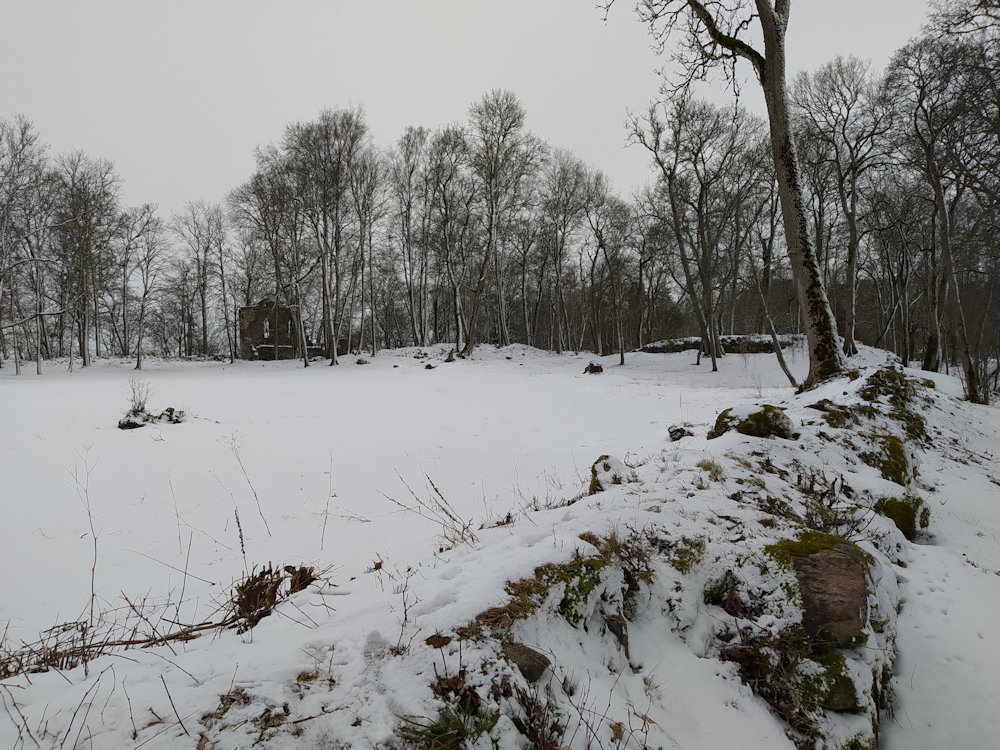

*RUINS OF THE CASTLE OF THE LEUVIR ORDER AND NEW CASTLE. We buy tickets for both castles and begin by exploring the oldest part of the complex. The Sigulda Castle of the Livonian Order was built in 1207 as a castella, but was later converted into a monastery. Currently, only the northern and main gate towers of the castle are accessible. We begin with the northern tower, so we ascend the wooden structure, which has been inserted into the interior of the castle in modern times, without interfering with or destroying the original walls. The 14th century saw the transformation of the former castellum into a typical monastery castle. The three-story, southwest section of the monastery building remains preserved to this day. At the southern end of the second floor was a ten-meter-wide chapel with Gothic window lintels and a pointed arch. Its wall was decorated with a cross. The third floor was used for storing weapons. SIGULDA – NEW CASTLE. Between 1878 and 1881, Prince Kropotkin’s family built a new castle near the old one. It was built in the neo-Gothic style, using materials from an older building that had stood on the same site in the 17th century. The architects designed the castle so that every window offered a beautiful view of the Gauja Valley. Unfortunately, World War I severely damaged it. In 1922, the Latvian Union of Writers and Journalists rebuilt the castle and established its headquarters there. In 1934, reconstruction work was carried out and the castle was rebuilt: the observation tower was raised, the terrace surrounding the building was widened, and a new balcony was added to the second floor. During World War II, the German Northern Army established its headquarters here. After the war, the USSR converted the castle into a rest home for high-ranking government officials, and later into the Sigulda Rehabilitation Center. Today, the castle houses the seat of the Sigulda Regional Council. The interiors also gained new splendor during the renovation and became the most significant example of modern national design in the Baltic region.

*Accommodation. Sigulda, like the entire Guaja National Park region, has a wide range of accommodations, and everyone will find something for themselves. Here, you’ll relax surrounded by fantastic nature and architecture. Plus, you’ll see much more than we managed in one day, because you simply won’t waste time traveling from the capital. To book accommodation, I recommend the website: www.booking.com
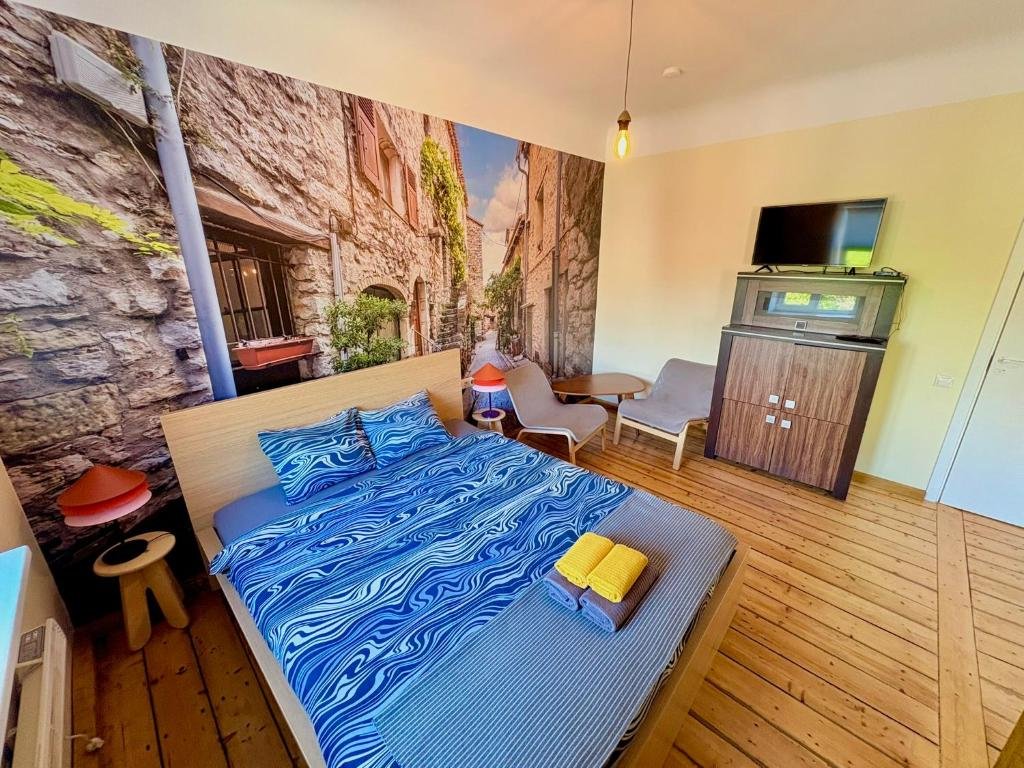
*Hotel. Fresh Apartments – Comfortable City Stays in Riga. Fresh Apartments – Comfortable City Stays in Riga is located in the Latgales priekšpilsēta district of Riga. Daugava Stadium is less than 1 km away, and Vermanes Park is 1.4 miles away. Free WiFi is provided. Private parking is available on site. All units feature a flat-screen TV, a private bathroom, and a fully equipped kitchen with a refrigerator. A stovetop and kettle are also available. Riga Nativity Cathedral is 1.7 miles away, and Arena Riga is 1.7 miles away. Riga International Airport is 8.1 miles away.