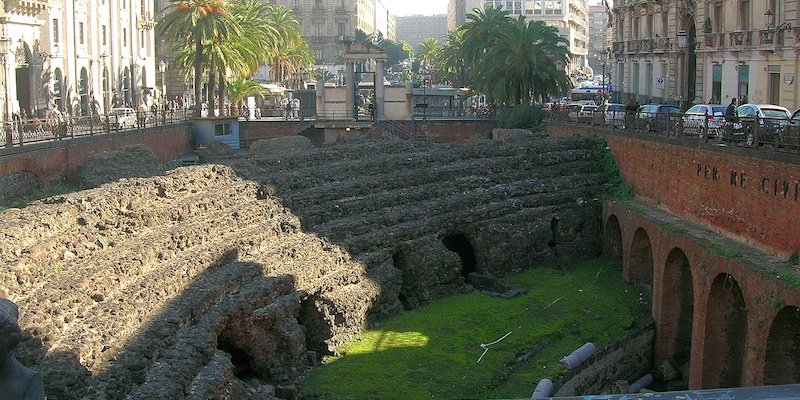
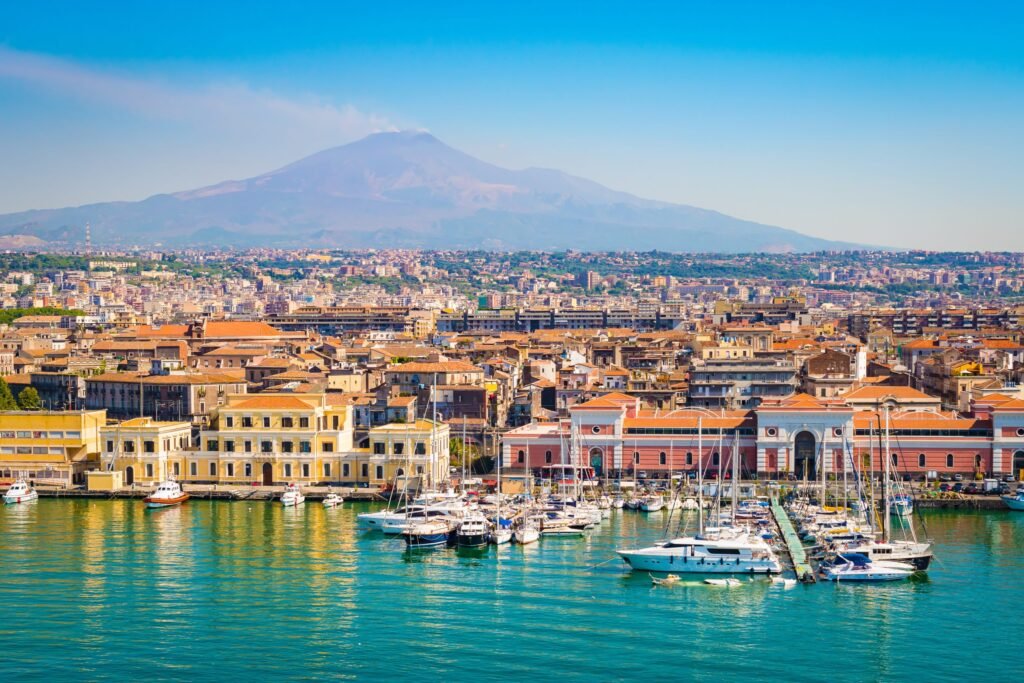
Catania is a city and port in the Sicilian region, in the province of Catania, Italy, at the foot of Mount Etna. Catania lies on the eastern coast of Sicily at the northern end of the Gulf of Catania, at the foot of Mount Etna. Catania’s location at the foot of Mount Etna has been a source of both advantages and disadvantages for the city. Volcanic eruptions devastated much of the city’s territory, but on the other hand, the volcanic ash produced highly fertile soil (volcanic soils), particularly suited to grape cultivation. The Amenano River flows beneath the city, visible at one point south of Piazza Duomo. The Longane (or Longina) River also flows through the city.
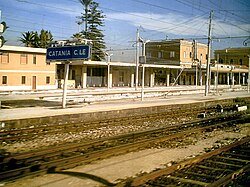
Transportation: Catania has a seaport and Fontanarossa International Airport, and the city is a hub of the Sicilian motorway system. The motorways serving Catania are the A18 Messina-Catania and the A19 Palermo-Catania. The extension of the A18 towards Syracuse and Gela is currently under construction. The city is home to the Catania Centrale railway station. It is also the starting point of the Circumetnea narrow-gauge railway, which encircles Mount Etna. Since 1999, the city has had a metro system, covering the former Circumetnei stations from Catania Porto to Catania Borgo. The metro line is 3.8 km long and has six stations. Plans are underway to extend the metro to Fontanarossa Airport, among other destinations.
Sport. The city is home to the Calcio Catania football club. In October 2011, Catania hosted the World Fencing Championships (for both able-bodied and disabled people).
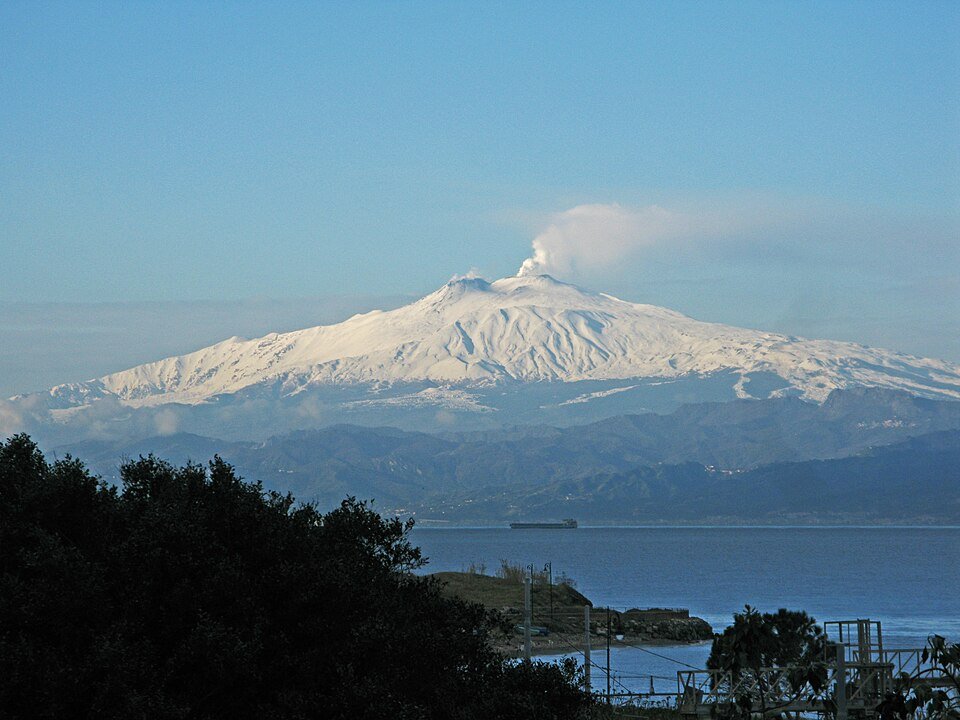
Etna is an active stratovolcano in Italy, on the eastern coast of Sicily. It is the highest and largest volcanic cone in Europe. Etna covers an area of at least 1,250 km². The volcano began forming approximately 500,000 years ago. The first records of eruptions date back to around 1500 BC. It is estimated that there have been over 200 eruptions since then. Its current elevation is approximately 3,357 m above sea level (volcanic activity causes elevation changes). Since 1987, part of Etna has been protected by the Etna Regional Park. In 2013, the volcano was added to the UNESCO World Heritage List.
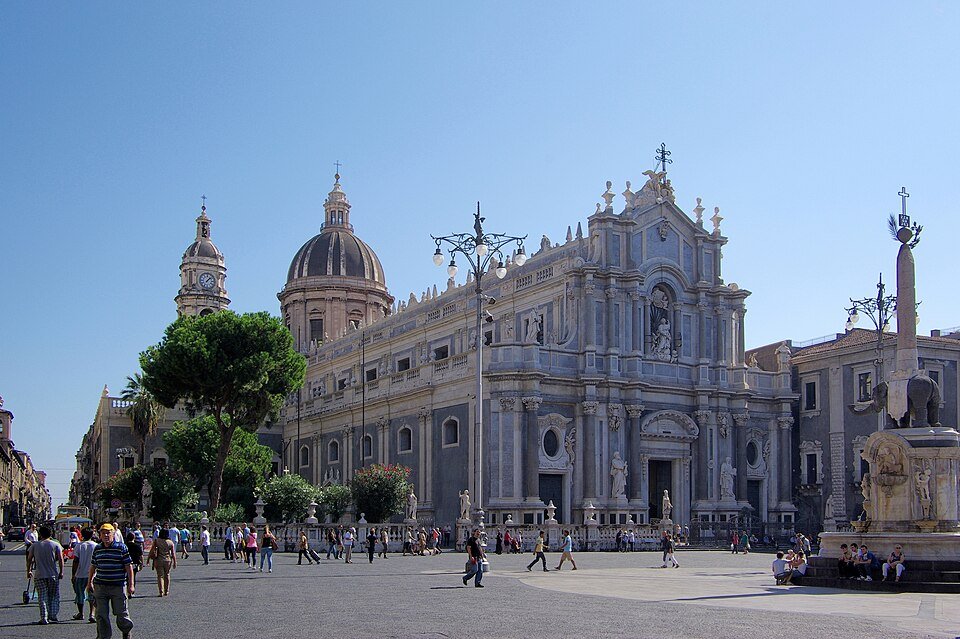
The Cathedral of St. Agatha is a Roman Catholic cathedral in the Sicilian city of Catania. It is a Baroque church, topped by a dome at the intersection of the transept and nave. It also has an ambulatory. The cathedral was built between 1078 and 1093. It was repeatedly damaged by earthquakes. Reconstruction in the 17th century, following one of the earthquakes, gave the basilica its present appearance.
Collegiate Church (S. Maria dell’Elemosina, Royal Chapel). Via Etnea No. 23, near the University building. The Baroque Collegiate Church, dedicated to Maria Santissima dell’Elemosina, existed before the 1693 earthquake and was rebuilt in the early 18th century. The design is attributed to Angelo Italia, who reversed the orientation of the new building with respect to the previous one, destroyed by the earthquake, so that it appeared as envisaged in the plan for the reconstruction of Via Uzeda (now Via Etnea). The Baroque façade, designed by Stefano Ittar, is a two-commissioned structure. The first row features six stone columns topped by a balustrade. The second row features a central window flanked by four statues: St. Peter, St. Paul, St. Agatha, and St. Apollonia. The entrance is preceded by a large staircase bounded by a wrought-iron gate. The interior, with its three naves, contains various preserved works, including: paintings of St. Apollonia and St. Euplio by Olivio Sozzi; a canvas depicting the Martyrdom of St. Agatha by Francesco Gramignani; an altar containing a marble statue of the Madonna; and an 18th-century wooden organ. The fresco on the vault is by Giuseppe Sciuti (1896).
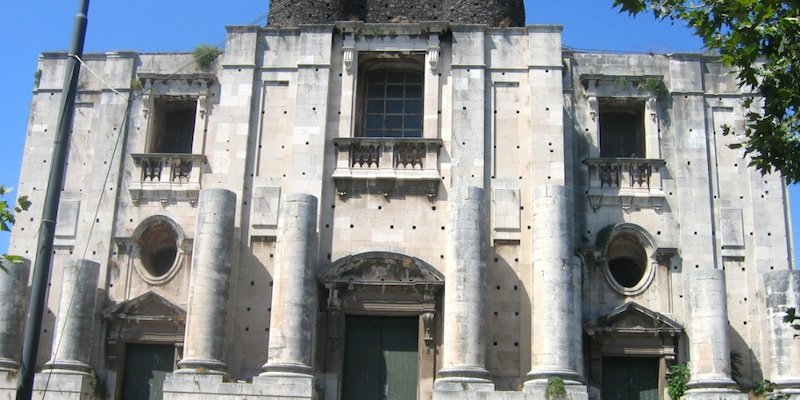
The Church of San Nicolò l’Arena in Catania is one of the largest Catholic religious buildings in Sicily, measuring 105 meters long and 48 meters wide at the aisles and approximately 71 meters at the transept, with a maximum height of approximately 66 meters up to the dome. Its construction dates back to the eruption of Mount Etna in 1669 and replaces an older Renaissance church. The first church built by the Benedictines in Catania was titled Sancti Nicolai de Arenis, literally San Nicola dell’Arena, later translated into its current name and inspired by the monks’ devotion to San Nicola di Bari and the soil known as red sand, which characterized the first monastic complex built in Nicolò, from which came the monks who founded the magnificent Monastery of San Nicolò l’Arena. The red sand of the village of Nicolò comes from the high temperatures of the earth, boiled by lava.
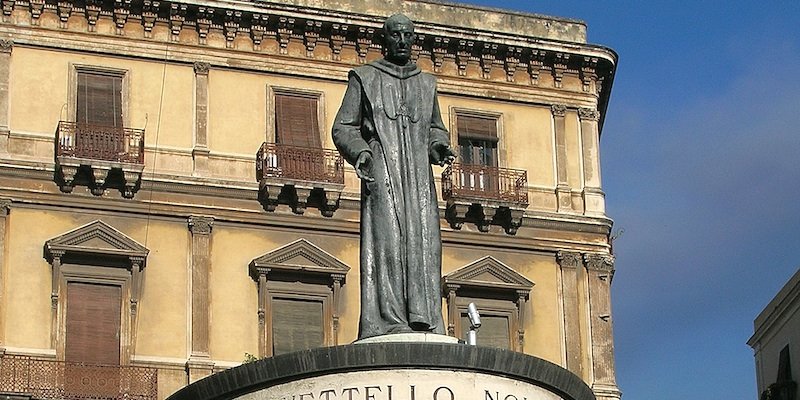
Giuseppe Benedetto Dusmet (August 1818 – April 1894), born Giuseppe Dusmet, was an Italian Roman Catholic cardinal. He took the name “Benedetto” upon joining the Order of Saint Benedict. He was beatified on September 25, 1988, by Pope John Paul II, and his canonization is still pending. Dusmet was born in Palermo in 1818 to Luigi Dusmet and Maria dei Dragonetti. Dusmet was educated at the Abbey of San Martino delle Scales from the age of five and later taught philosophy and theology in Benedictine houses. He joined the Order of Saint Benedict. Benedict and chose the name “Benedetto” as his middle name after taking formal vows on August 13, 1840. He was appointed Archbishop of Catania by Pope Pius IX in 1867 and was later elevated to cardinal in 1889 by Pope Leo XIII.
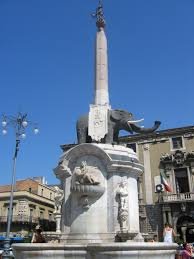
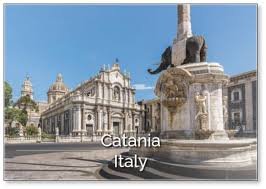
The Fontana dell’Elefante, the captivating fountain in the center of Piazza Duomo in Catania, is much more than a simple water feature. It is a striking emblem of the city, a testament to its unique blend of ancient legends and Baroque craftsmanship, and a stage where the enigmatic past intertwines with the vibrant present. More than just a decorative element, this fountain is a living symbol of Catania, a space where the whispers of ancient knowledge mingle with the contemporary bustle of city life. It is a place where a mysterious basalt elephant meets an elegant Baroque obelisk, offering a profound connection to both the city’s ancient roots and its artistic evolution.
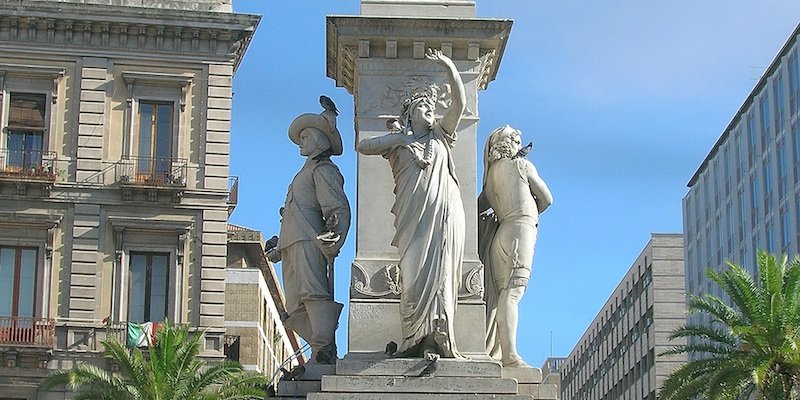
The Vincenzo Bellini monument is located in the center of the eastern part of Piazza Stesicoro. The monument was created by sculptor Giulio Monteverde, commissioned by the Municipality of Catania, and inaugurated on September 21, 1882. Its location remained dormant until the end, as it was impossible to decide where to place it. The Catanese group wanted to place it in front of the Massimo Bellini Theatre, and then, during construction, another instead of the Elephant Fountain in Piazza Duomo. Only in the end did the proposal to move it to Piazza Stesicoro prevail. The statue seems to have been placed in a “strategic” position, because during the days of celebration dedicated to the patron saint of Catania (Sant’Agata), when the fercolo is in Piazza Stesicoro, Vincenzo Bellini himself seems to look away.