
Fez is a city in northern Morocco, the administrative seat of the Fez-Meknes region. In 2024, it had a population of approximately 1.2 million.
A bit of history. The city was founded by Idris I in the 8th century CE. Initially a small town, it expanded significantly in the following century, when in 807 the next ruler, Idris II, established Morocco’s first capital here. Refugees arrived in the city from the two most important centers of the Islamic world at the time – Cordoba in Andalusia and Kairouan in Tunisia. Their influence led to Fez’s rapid development. By the end of the 10th century, the city was the undisputed cultural, religious, and economic center of the Moroccan state. Medieval European visitors saw it as both a capital of fanaticism (it was one of Islam’s holiest cities) and a center of learning, with medicine, philosophy, and mathematics flourishing here. A major religious and scientific center in medieval Fez was the Al-Qarawiyyin Mosque, built in 857. Fez declined in importance during the reign of the Almoravid dynasty (11th–12th centuries) and the Almohad dynasty (12th–13th centuries), when the capital of the Moroccan state was located in Marrakesh. Only the sultans of the succeeding Marinid dynasty restored Fez as their capital and significantly enhanced the city’s splendour. However, Fez declined again under the Saadi dynasty, who once again chose Marrakesh as their capital. It was not until the first rulers of the Alaouite dynasty, in the early 17th century, that the city was restored to its former importance – the first Moroccan sultan of this dynasty, Moulay Rashid, reigned there. However, his brother and successor, Moulay Ismail, was known for his hostility towards the inhabitants of Fez, imposing heavy taxes on them, and relocating his court to nearby Meknes. After his death, Fez was restored as the capital, but power struggles erupted that lasted until the second half of the 18th century, and the successive sultans, who briefly held the throne, invested primarily in wars and palace expansion. Only the reign of Muhammad III brought relative peace and development to the city. Under French colonial rule, the city continued to develop, with the creation of a modern ville nouvelle district. However, since the beginning of French rule, the city has played a lesser role due to the French moving the capital to Rabat. Today, however, Fez is a major economic and tourist center, as well as a religious center. In 1981, the medina of Fez was added to the UNESCO World Heritage List. In 2001, a botanical garden was established in Fez.
The Old City (Medina). The medina in Fez is a maze of narrow streets (sometimes very narrow, tight, and at times dark) that form a vast labyrinth. It is the largest medina – a medieval Arab city – in the world, and the one in Marrakesh is like a single district next to it. It has been designated a UNESCO World Heritage Site. It is essentially divided into two parts, the most difficult to explore, the most “confusing,” and the oldest of which is Fes el-Bali. This is where all the most important monuments, most interesting places, and nooks and crannies are located. Fes el-Jdid is the younger part, home to the Royal Palace, guarded by guards and surrounded by walls. Even the most experienced tourist at reading city maps can get lost here more than once, not twice. Google Maps’ blue “ball” can also be unreliable, occasionally going haywire. A moment’s hesitation, a quick reconnaissance with a map in hand, can prove fatal. Hidden in almost every corner of the medina are self-proclaimed guides who will strike up a conversation, offer help (for a fee, though they’ll insist they’re just students and don’t want any money), and it’ll be hard to get away from them. Incidentally, if you do give in, they’ll be happy to take you to a friendly restaurant or shop. A good idea is to organize, perhaps with the help of hotel staff or through Airbnb, a several-hour tour with a real guide who will show you all the most important sites in the medina. No one will bother you, and you’ll even be able to enter places you’d struggle to access on your own, like a bakery or the back of a pastry shop.
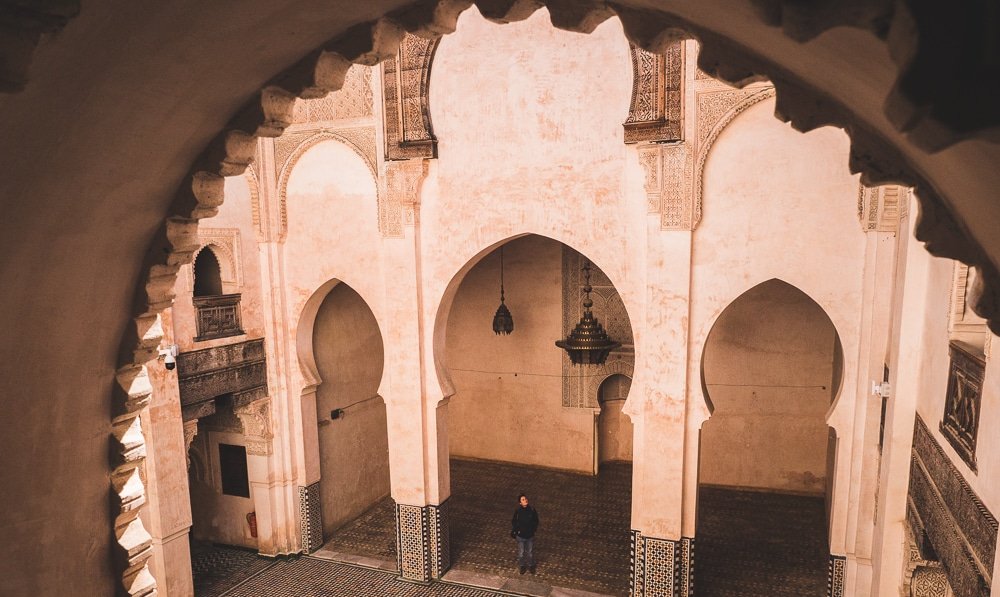
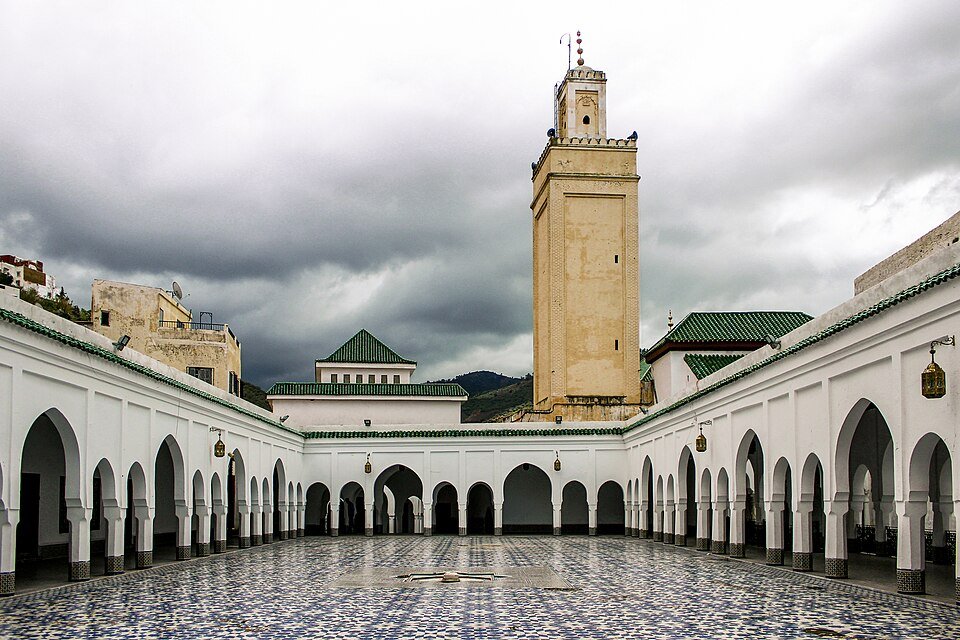
The Kairouan Mosque (Quranic School Madrasah). One of the most important, if not the most important, monuments in Fez is the Great Mosque, or the Mosque of Al-Qarawiyyin. It features a distinctive green roof and a minaret towering over the old city. It was founded in the 9th century by Lalla al-Fihrya, an immigrant from Kairouan. It is the second largest mosque in Morocco. The largest is in Casablanca (the Hassan II Mosque), which can accommodate over 20,000 worshippers. This number is truly impressive, although looking at it from the roof of our riad, it didn’t seem so vast. This is probably because it is nestled within the dense development of the medina. However, only Muslims are allowed inside, and even in the courtyard. It was at this mosque that the university, which was the center of scientific thought at the time, was founded in the 9th century. It’s the oldest university in the world (the University of Bologna dates back to the 11th century, and Oxford to the 12th). You can easily visit the beautiful, ornate, 14th-century Madrasa Al-Attarine. Besides the courtyard with its fountain, you can also visit the upper floor, which housed the former student cells. From here, you’ll find the former Spice Market (Souq Attarine), which is adjacent to the Hanna Market, as well as the covered luxury market (Kissaria). This part of the medina also houses the aforementioned Mausoleum of Idris II (also off-limits).
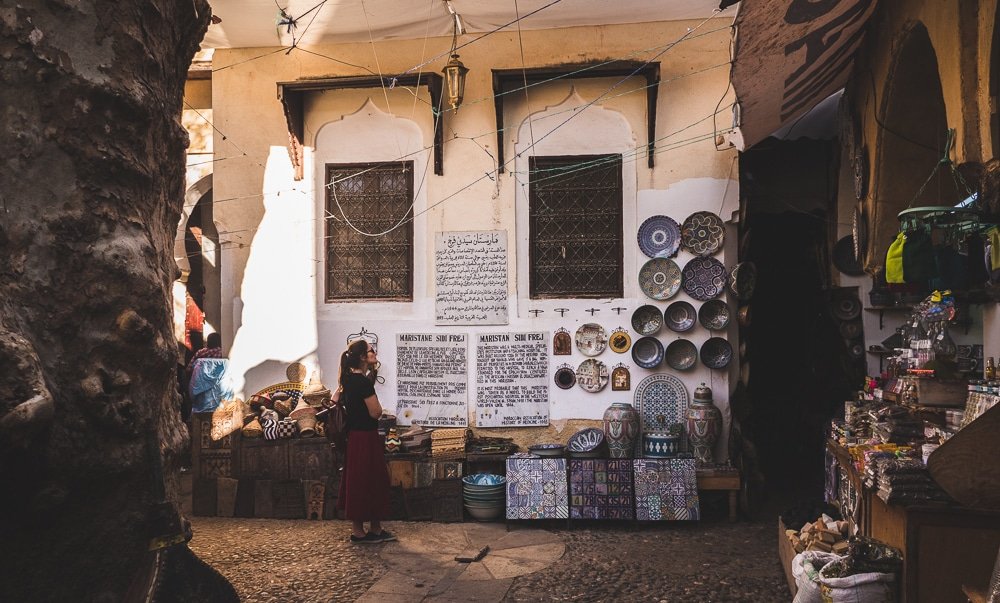
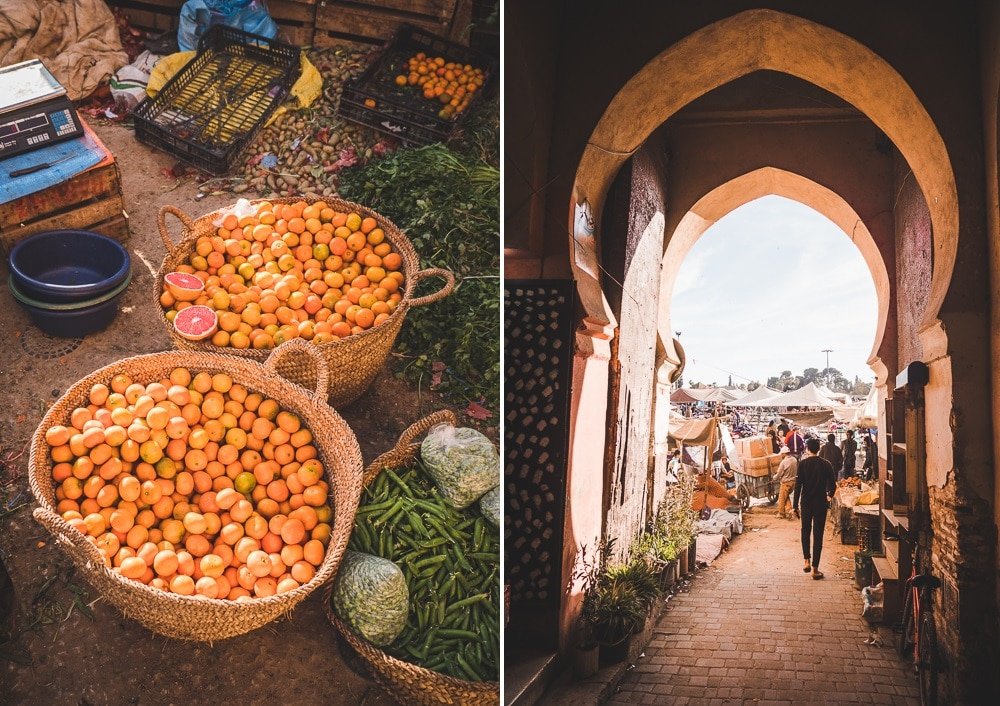
Souks: Ceramic and Metal. The medina in Fez differs not only in size from that in Marrakesh, but also, unlike the latter, has many different, large and small, themed souks. This is intended to make shopping easier for residents; everyone knows where to buy, for example, the best vegetables and fruit, clothes for special occasions, and spices and other food products. Some “markets” are elegant and covered (for example, the one right next to the Royal Palace), others date back to the city’s early days. Fez and its inhabitants are renowned for their handicrafts; since ancient times, crafts have developed here at the highest level. These include not only leather products – cow, sheep, or camel – but also magnificent, ornate wooden objects, weaving, decorative arts such as mosaics, and ceramic and metalwork. You can admire these as you pass by small artisan workshops, where skills have been passed down from generation to generation. A particularly charming spot, where artisans who “enchant” metal work, set up shop is Seffarine Square, near the Al-Karaouine Mosque. The sounds of work can be heard from afar, as bowls, lamps, jugs, large vats, and tiny figurines arrive at the local souk. Equally picturesque is the small square where beautiful ceramics are displayed for sale. These traditional ceramics from Fez are typically white and blue.
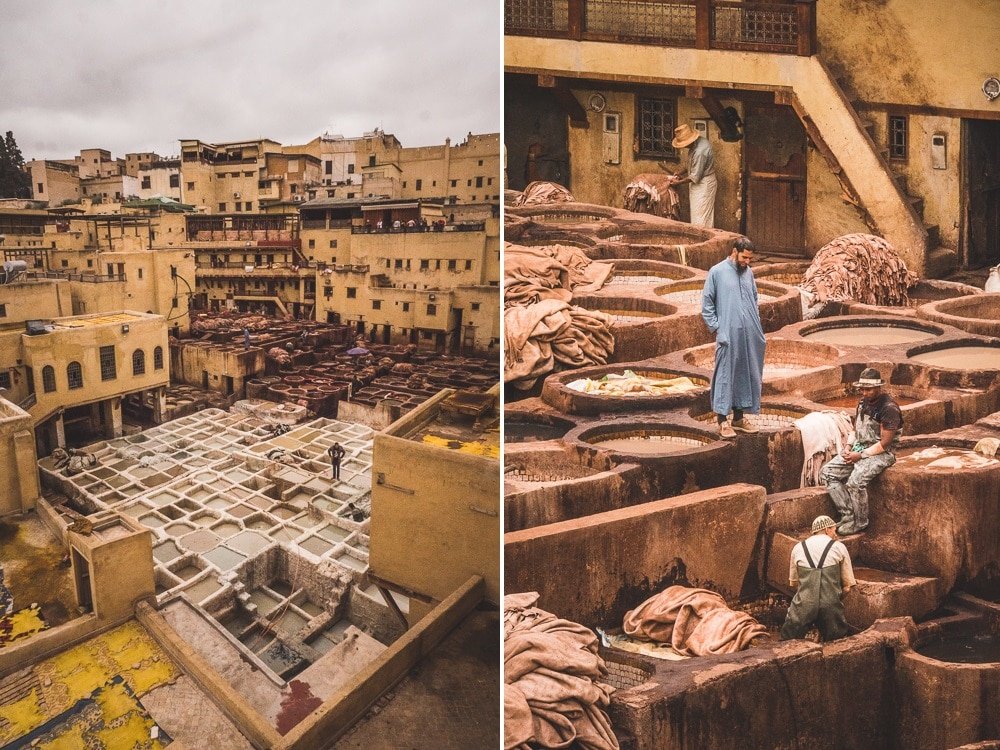
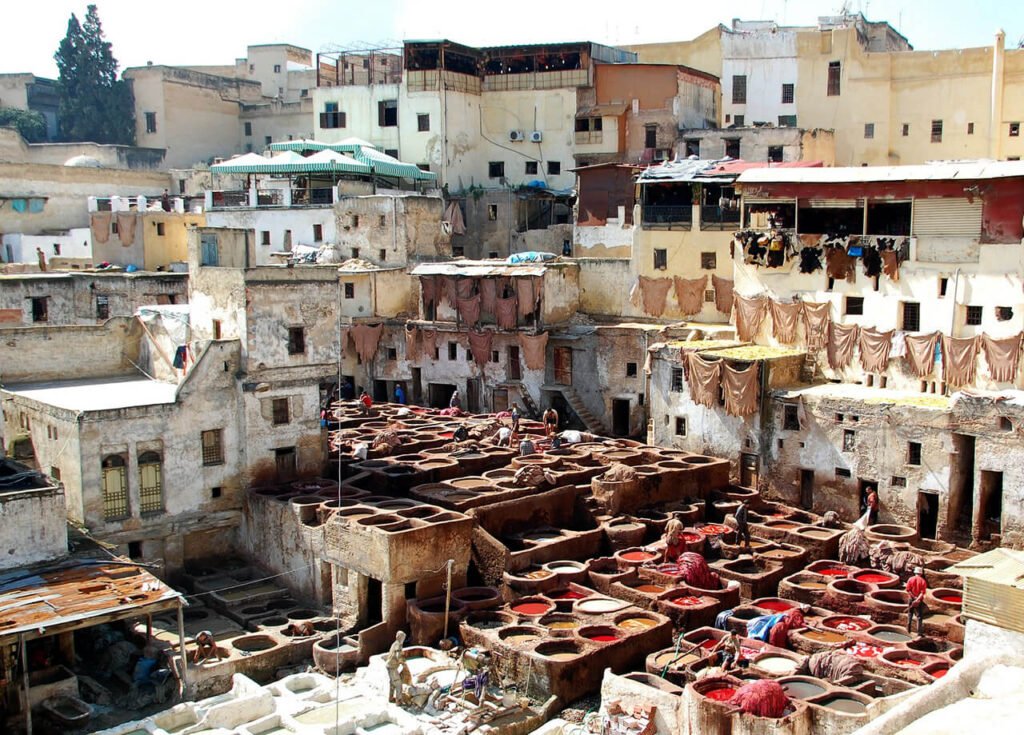
Leather dyeing. This is what Fez is primarily associated with – tanneries and leather dyeing. The city is famous for its exquisite leather goods – jackets, coats, shoes, handbags, wallets, and so on. Some are truly expensive, but also, as is immediately apparent, of exceptional quality. The largest is the Chouwara tannery and dyeing plant. The vast area, filled to the brim with vats of colorful dyes, can be viewed from the surrounding observation decks. Here and there, dyed hides are hung. Yellow hides are said to be the most valuable, as this dye is the most expensive. The men working there clean the hide, prepare it for dyeing, and then soak it in the vats. This is very hard and demanding work. Before climbing to the roof (after passing through several floors of leather goods shops), they offer us a sprig or two of mint to quench the unpleasant odor emanating from the factory. We were here with our guide, so the vendors were kind to us and didn’t push us to buy anything. Besides, due to the time of year (early March) and the weather (it was the least sunny and coldest day – around 15-16 degrees Celsius), the smell emanating from the tannery wasn’t overpowering.
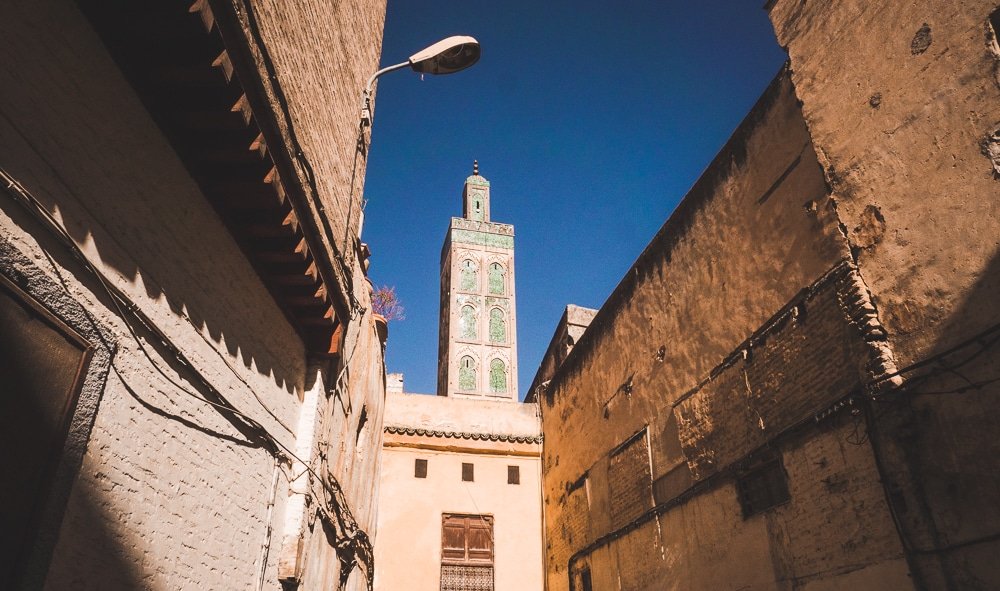
The Andalusian Quarter. The Andalusian Quarter is part of the oldest part of the medina, Fes el-Bali. It was here, on the eastern side of the river, that Muslim immigrants from Andalusia, particularly from Córdoba, settled. The district’s most important monument is the Andalusian Mosque, dating back to the 9th century. Its main gate, especially its highly ornate wooden finishes, are very charming, as is the adjacent fountain. The minaret resembles that of the Kairouan Mosque. Unfortunately, only Muslims are allowed to enter, although you’ll likely encounter a “guide” who will try to convince you otherwise and invite you to join them for a guided tour. Don’t be fooled. However, you can peek through a side gate into the courtyard. Adjacent to the mosque are two madrasas – the Sahrij and another Koranic school founded in the 4th century.
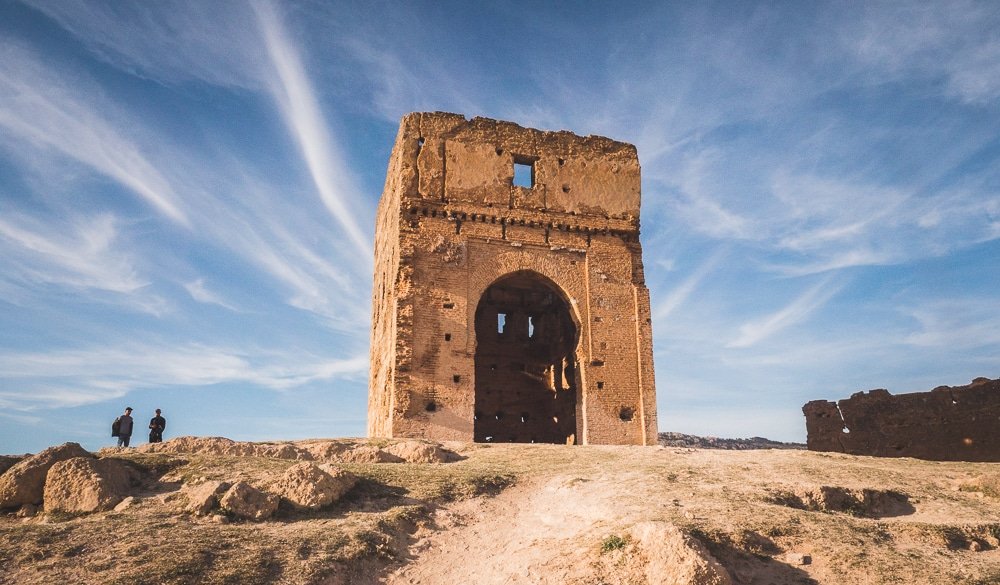
The Merinides Tombs. On El-Qolla Hill above the city and adjacent to the Les Merinides hotel complex lie the remains of the tombs of the Merinides dynasty – sultans who ruled Morocco from the 13th to 15th centuries, based in Fez. I recommend visiting at the end of the day, as the hill offers panoramic views of the Fez medina, as well as the mountains and gentle hills, already green at this time of year, where you can spot small dots of grazing sheep. Right next to it is a modern cemetery (Cimentiere Bab Guissa), divided by a two-lane road with white tombs. Not only tourists and locals stroll through this area, but also sheep, quite numerous at that. The closest city gate to the necropolis is Bab Guissa. Not far from the tombs and the aforementioned hotel complex and bus station, another interesting structure stands – Borj Nord, a 16th-century defensive bastion built by the Saadian dynasty (today housing the Arms Museum). It’s important to note that visiting Muslim cemeteries on Fridays is not considered good practice if you are of a different faith.
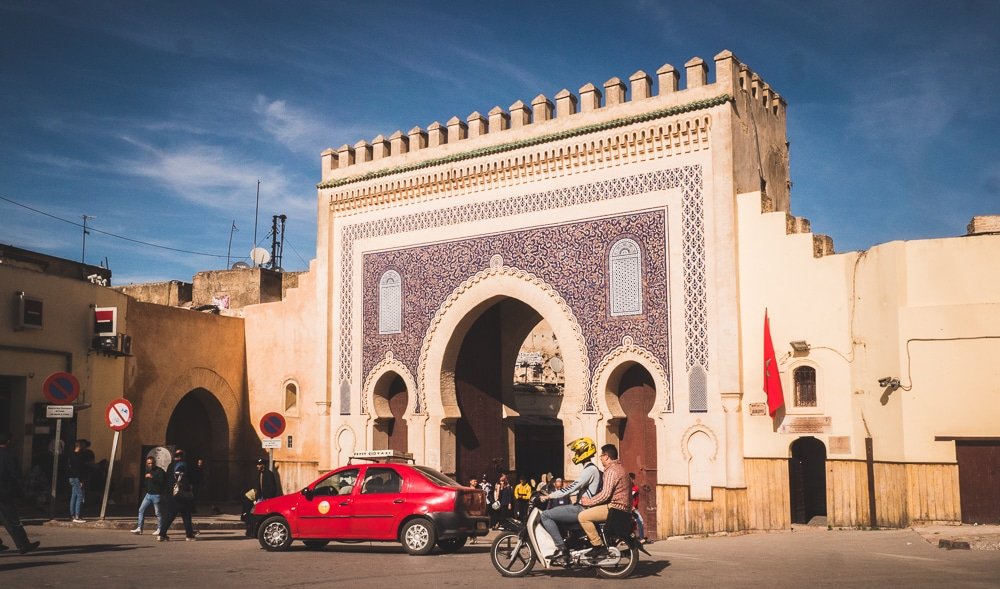
The Blue Gate. Bab Bou Jeloud, commonly known as the Blue Gate (due to its beautiful blue tile decorations on the exterior and green on the medina side), is perhaps the most frequently photographed gate, usually appearing in brochures advertising Fez. Entering Fes el Bali through it, it’s worth taking a moment to relax in the café on the small square just in front. From here, you can snap a photo of the gate and the minarets of the nearby Bou Inania mosque and madrasa. Crossing Bab Bou Jeloud, you enter a world of souks offering a variety of goods, from handbags to slippers, and beckoning vendors. From here, you can walk directly into the heart of the medina, the Andalusian Quarter, with its famous mosque.
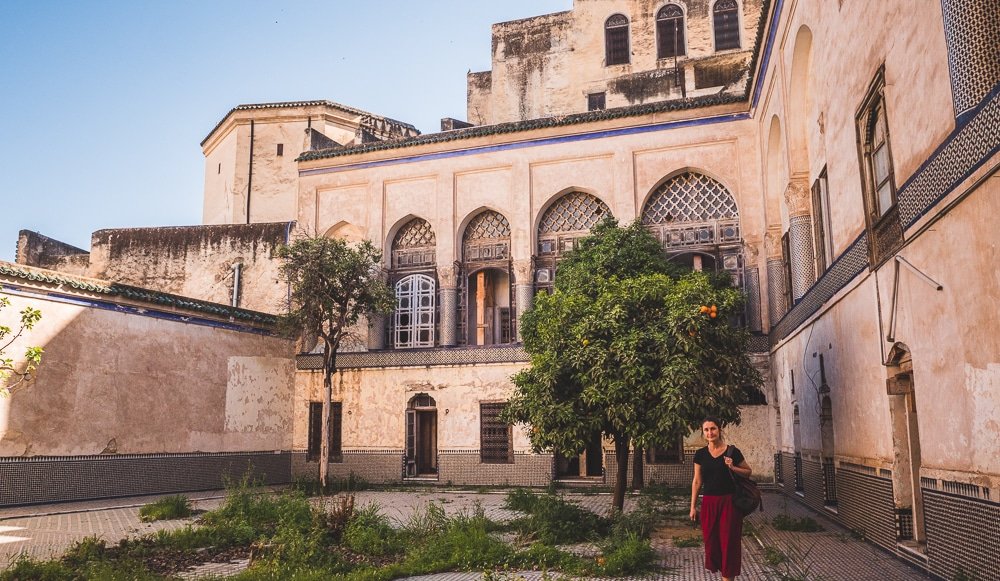
The abandoned Mukri Palace. The palace belonged to one of Fez’s wealthiest merchant families, and a small section of it is now a hotel, but the larger section—with its wild orange trees on the terrace—has also fallen into disuse and abandoned. Mosaics and stuccoes dating back to as early as 1600 can be viewed up close. This palace could prove to be a future tourist attraction in Fez.
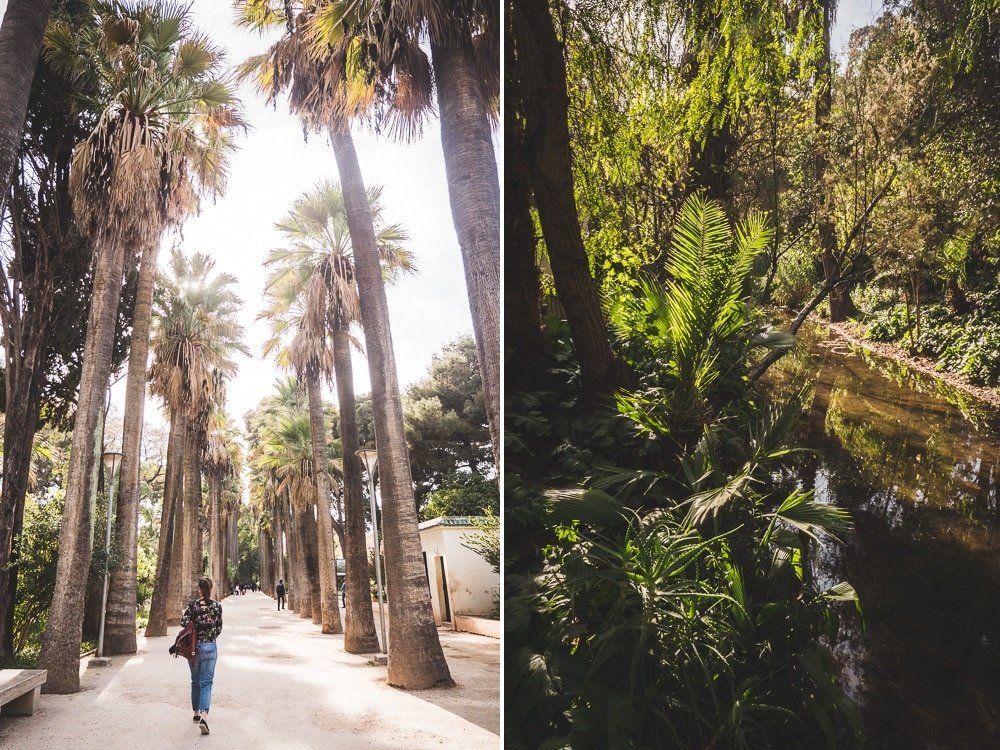
Municipal Park – Jnan Sbil. Between Fes el-Bali and Fes el-Jdid stretches a pleasant municipal park, fragrant with orange blossoms in March. It’s a good place to take a break from the hustle and bustle of the crowded medina. On the way from the old part of the medina, you can stop at the 19th-century Dar Batha Palace (now a museum), which is unfortunately currently under renovation, a shame, as it supposedly houses beautiful interiors. The park itself is a very pretty, lush green, quiet, and peaceful place with neatly marked paths and flowerbeds. Of course, there’s a fountain, and at the end of the day, cranes gather on the artificial lake with the island.
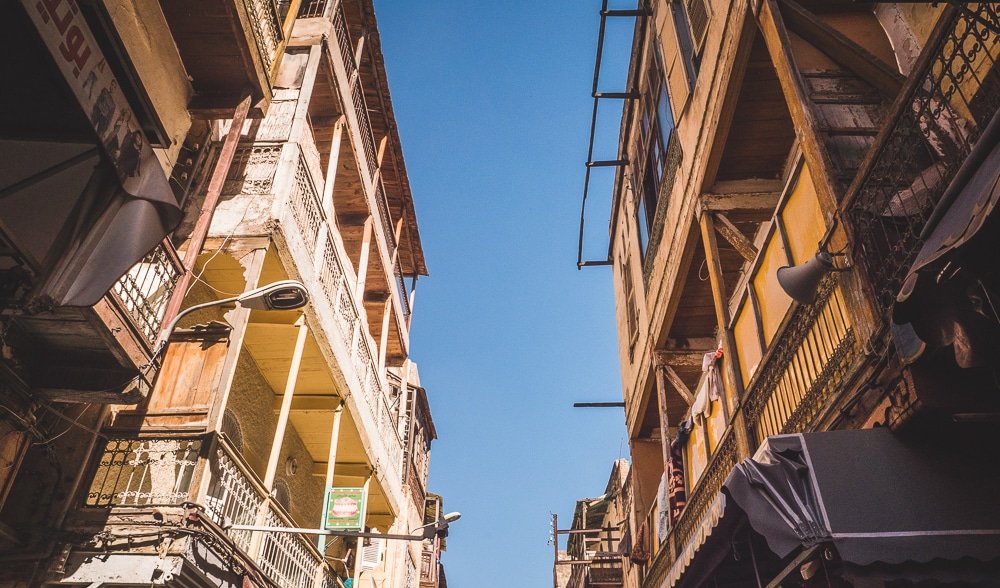
The Jewish Quarter. Mellah. Right next to the vast, walled Royal Palace complex, in the newer, 12th-century part of Fes el-Jdid, stretches the mellah, or former Jewish Quarter. The sultan ordered Jews to move here from the old part of the city in the 13th century to separate them from the Muslim community and to keep them close to him – under control and watchful eye. The difference between this and other parts of the medina is immediately apparent. The buildings are much taller, the streets less cramped, and the houses feature wrought-iron balconies, wooden annexes, and large windows facing the main streets. Some, though considerably damaged by time, are truly impressive. Two synagogues and a Jewish cemetery also remain here today. It also turned out that storks took a liking to the mellah, circling the gates and even building several nests.
